BONDS UNSUNG
REVIVAL OF AN AMERICAN LEGACY
Sequina DuBose soprano
Gregory Thompson piano
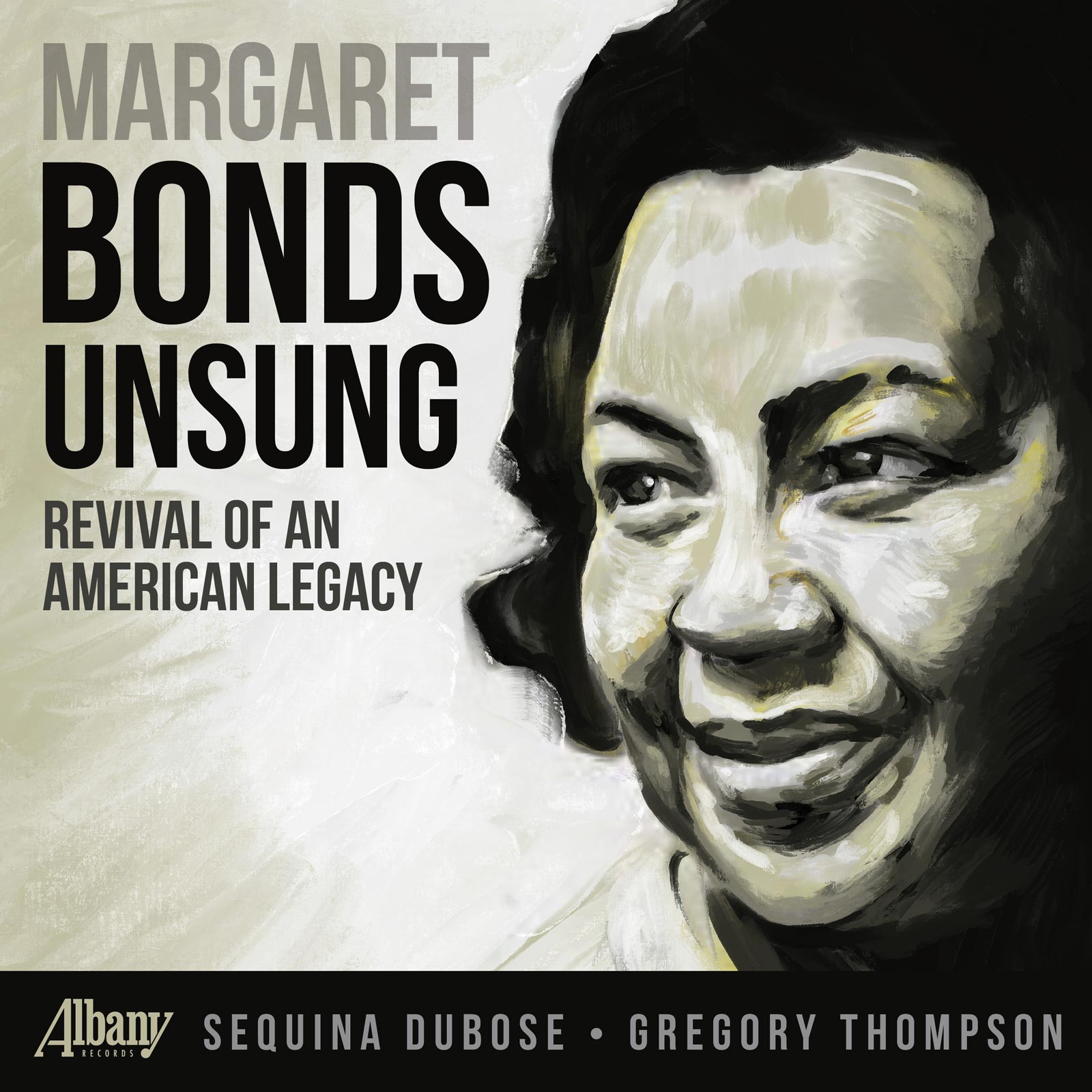
Composer Margaret Bonds is chiefly remembered for two things: her music, and her ability to shatter seemingly-unbreakable glass ceilings in the music industry as a Black woman in the early-to-mid 20th century. Soprano Sequina DuBose champions these achievements on BONDS UNSUNG, a cross section of vocal works ranging from piano-voice duos to large choral compositions.
Considering the obstacles that Bonds faced, it is not surprising that her works feature a consistent undercurrent of defiance. What's remarkable is how varied this energy develops in the individual pieces: blossoming into delicate lyricism here, bursting into exaltation there. DuBose is the perfect match for these works, as is the rest of the ensemble.
TRACK LISTING
ABOUT THE MUSIC
BONDS UNSUNG presents the single most comprehensive recorded anthology of Margaret Bonds' contributions to the spiritual ever ventured — including not only powerful new recordings of the already-recorded spirituals You Can Tell the World, Ev'ry Time I Feel the Spirit, and Sinner, Please Don't Let This Harvest Pass, but also two solo spirituals (Hand Me Down and Nebuchadnezzar) and two choral spirituals (I Wish I Knew How It Would Feel to Be Free and We Shall Overcome) that have only recently been published and never before recorded.
DuBose and friends complement the spirituals on BONDS UNSUNG with two works that drink deeply from the well of popular music: the sumptuous vocal jazz-ensemble piece Mist over Manhattan from Bonds' co-written play Midtown Affair about interracial love and the deadly violence inherent in racial hatred; and the Note on Commercial Theater — Bonds' final art song on a poem of her friend Langston Hughes — which offers an impassioned and searingly beautiful blues-inspired condemnation of white cultural appropriations of Black art.
The album rounds out with solo and choral selections from the magnum opus of the composer's entire output: the late musical Bitter Laurel, composed with a team of collaborators Bonds assembled immediately after moving to Los Angeles in 1967. This recording features the first commercial recordings from the reconstructed Bitter Laurel, including the solo reprise of What a Big World This Is restored as an optional number in the newly edited score.
Tracks 1-4, 9-11, 13-14, 16-18
Recorded April 27 & May 27, 2026 at The Wav Lab in Fort Mill SC
Session Engineer: Joe Miller
Tracks 5-8, 12, 15
Recorded April 26, 2026 at Rowe Recital Hall, UNC Charlotte in Charlotte NC
Session Engineer: Joe Miller
Assistants: Adam Whittemore, Christen Crumpler
SONG NOTES
Ev'ry Time I Feel the Spirit
Written late in Bonds' career for soprano Leontyne Price
Transforms a familiar spiritual into a vivid expression of spiritual awakening. Expansive vocal lines, rich harmonies, and increasingly animated gospel-influenced piano writing capture the joy, movement, and emotional power suggested by the text.
Nebuchadnezzar
Bonds' earliest surviving spiritual setting
Draws upon the biblical story of the Babylonian king whose pride leads to downfall. With its declamatory vocal writing and propulsive rhythms, the song reveals Bonds' gift for musical storytelling and dramatic characterization.
You Can Tell the World
One of Bonds' most enduring spiritual settings
Driven by rhythmic vitality and infused with gospel and boogie-woogie influences, the work embodies Bonds' belief that spirituals could function simultaneously as concert music and communal expression.
Hand Me Down
Drawing upon a spiritual long cherished within African American religious traditions
Blends folk expression with sophisticated compositional craft. Trumpet-like figures in the piano evoke images of redemption and transformation, while the work's dramatic vocal writing underscores Bonds' ability to elevate vernacular materials within a concert setting.
Sinner, Please Don't Let This Harvest Pass
Composed for Leontyne Price
Combines lyrical beauty with a compelling sense of urgency. Bonds transforms the spiritual's harvest imagery into a reflection on faith, responsibility, and redemption, while rhythmic gestures in the accompaniment evoke the labor and perseverance at the heart of the text.
We Shall Overcome
Created in 1969 for Leontyne Price and the Rust College A Cappella Choir
Margaret Bonds' arrangement of the Civil Rights anthem reflects her deep commitment to social justice and the transformative power of music. Created in 1969, the work remained unheard during Bonds' lifetime. This recording restores an important chapter in her artistic and cultural legacy.
I Wish I Knew How It Would Feel to Be Free
Originally by Billy Taylor with lyrics by Dick Dallas, arranged by Bonds in 1969
At the request of longtime friend soprano Leontyne Price, Margaret Bonds created a new arrangement for soloist and the Rust College A Cappella Choir, infusing the song with her distinctive harmonic language and dramatic approach to text setting. Through vivid text painting, Bonds mirrors the imagery of a bird flapping its wings, rising toward the sun.
Mist Over Manhattan
Adapted from Bonds' musical Midtown Affair
Written during Bonds' years in New York City, the song reflects the influence of Tin Pan Alley, vocal jazz, and mid-century musical theater. Set against a story of interracial love and social prejudice, it combines popular song idioms with Bonds' distinctive melodic voice and sophisticated craftsmanship.
Note on Commercial Theater
Composed in 1960, Bonds' final art song on a text by Langston Hughes
Hughes's poem critiques the commercial exploitation of Black artists and Black culture while envisioning a future in which Black voices are celebrated on their own terms. Bonds responded with a blues-inflected setting that amplifies Hughes' message of artistic self-determination and cultural agency. The song opens with musical references to George Gershwin's Summertime from Porgy and Bess.
PERFORMERS
Sequina DuBose — soprano
Soprano Sequina DuBose is a soprano, recording artist, and scholar whose work centers on 21st-century hybrid vocal literature, particularly at the intersections of classical music, musical theater, jazz-influenced repertoire, and contemporary popular music styles.
Gregory Thompson — piano
Pianist Gregory Thompson is known for his work as a solo and collaborative artist in the United States, Europe, and Asia. Of his Carnegie Hall debut, The New York Times praised his "intuitive playing" and his ability to "make a melodic line sing and inflect it with delicate rubato effects."
The University Chorale of UNC Charlotte | Jason Dungee, director
The University Chorale is the flagship choral ensemble of the UNC Charlotte music department, consisting of both music majors and non-majors.
Royal Voices of Charlotte, Queens University | Justin Smith, director
Royal Voices of Charlotte was formed in 2019 by Dr. Justin Smith as an auditioned mixed choir performing a wide range of repertoire. They have performed by invitation at Carnegie Hall and won First Prize at the International Choral Kathaumixw in Canada.
Jade Emerson — percussion
Cornelia Cooper — soloist
Yoon Sun Song — piano
Drew Coley, Ezra Devane, Chloe Marks, Reshawn Murphy, Reem Nour, Aden Peters, Zareah Roberts, Jylian Taylor — voice
ACKNOWLEDGMENTS
This project was made possible through support from the University of North Carolina at Charlotte's Faculty Research Grant and the generosity of friends, colleagues, audience members, and supporters who contributed to the BONDS UNSUNG crowdfunding campaign.
Gratitude to Justin Smith (Bitter Laurel co-producer and co-commissioner), as well as the many scholars, collaborators, researchers, composers, and creative artists who contributed their expertise and insight: Jason Dungee, Christopher Washington, Margarette Joyner, Janaka Lewis, and Carla LeFevre. Special thanks to Elvira Green and Eleanor Boswell-Raine, whose participation in project discussions and public programming provided invaluable personal and historical perspective.
Sincere appreciation to Louise Toppin, and to Orestes Richardson and the Margaret Bonds Estate for their stewardship of Bonds's artistic legacy and their support of efforts to bring her music to new audiences.
Thanks to the students and musicians of Queens University of Charlotte and UNC Charlotte. Special thanks to husband and album cover artist Ajani Winston, and to Joe Miller of The WAV Lab for his exceptional artistry as recording, mixing, and mastering engineer.
Heartfelt thanks to John Michael Cooper for planting the seed that inspired this project and for providing invaluable resources, encouragement, and guidance throughout its development.
ALBUM NOTES
On Dr. Sequina DuBose's Bonds Unsung
— John Michael Cooper (Denton TX, June 2026)
As an African American woman who achieved international renown in a profoundly racist and sexist world, Margaret Bonds (1913–1972) knew how to make her mark. Her father instilled in her a fierce passion for social justice and her mother instilled in her an equally fierce sense of self — and these, together with her great intellect, talent, and penchant for originality, enabled her to rise from childhood as a prodigy in the resolutely segregated metropolis of Chicago, live through the geographic center of the deadly Chicago race riot of 1919, earn Bachelor's and Master's degrees from Northwestern University, and relocate to the United States' biggest city (New York) and there succeed as a performer, teacher, and social-justice activist over the span of nearly three decades. Then they enabled her, in the last five years of her life, to join the great migration of African Americans to Southern California, there breathing life into the musical facet of the nation's first and most influential minority-owned and operated multicultural, multi-ethnic, multi-racial, and multidisciplinary visual and performing arts institution: the Inner City Cultural Center of Los Angeles.
And she succeeded as a composer — which is where BONDS UNSUNG comes in. Bonds understood that in the world of classical music, the white and male-dominated music publishing industry used performers' dependency on printed and published music to ensure the in-life marginality and posthumous obscurity of non-whites and women. That understanding coupled with her musical genius to win her no fewer than eight publishers by the end of her life — including some of the largest firms in the United States. But with her death in 1972 the system resumed its work: most of the works she had published were allowed to go out of print; economic circumstances and the racist and sexist assumptions of those who managed libraries and archives made it impossible to gather her large estate into accessible curated collections; the disorganized state of her manuscripts and other effects made it vastly more difficult for scholars and other musicians to access her works as they accessed those of other musicians; and historians and theorists of music continued to produce article after article, volume after volume of writings about music that blithely ignored the fact that Bonds' formidable imagination, Black and female, had ever even existed.
That is the great wrong that BONDS UNSUNG tackles head-on. Here, Sequina DuBose and friends offer the single most comprehensive recorded anthology of Bonds' contributions to the spiritual ever ventured — including not only powerful new recordings of the already-recorded spirituals You Can Tell the World, Ev'ry Time I Feel the Spirit, and Sinner, Please Don't Let This Harvest Pass, but also two solo spirituals (Hand Me Down and Nebuchadnezzar) and two choral spirituals (I Wish I Knew How It Would Feel to Be Free and We Shall Overcome) that have only recently been published and never before recorded.
DuBose and friends complement the spirituals on BONDS UNSUNG with two works that drink deeply from the well of popular music: the sumptuous vocal jazz-ensemble piece Mist over Manhattan from Bonds' co-written play Midtown Affair about interracial love and the deadly violence inherent in racial hatred; and the Note on Commercial Theater — Bonds' final art song on a poem of her friend Langston Hughes — which offers an impassioned and searingly beautiful blues-inspired condemnation of white cultural appropriations of Black art. And they round these contributions out with solo and choral selections from the magnum opus of the composer's entire output: the late musical Bitter Laurel, which was composed with a team of collaborators Bonds assembled immediately after moving to Los Angeles in 1967.
But Bitter Laurel is also of greater significance — for it compellingly refutes the widely repeated but false narrative that Bonds' late California years were largely rudderless and produced nothing of artistic consequence. And, perhaps most importantly, by demonstrating what can happen when scholars and performers join forces and work together to combat the forces of systemic racism and sexism, it tenders an imperative for future such collaborations. For Bonds, however extraordinary, was not unique: countless other musicians of great talent have been marginalized to the point of obscurity by the same forces that BONDS UNSUNG challenges.
THE JOURNEY
My introduction to Margaret Bonds came long before I knew her name would become such a central part of my artistic life. As a high school student, I spent countless hours in the choir room under the mentorship of my choral director, Nina Scott. Between rehearsals, she would share recordings from her extensive music collection, exposing us to performances that expanded our understanding of what classical singing could be. One afternoon, she played the now iconic video recording of Spirituals in Concert featuring Kathleen Battle and Jessye Norman. I sat captivated as these extraordinary artists brought the spiritual to life with a level of artistry, dignity, and emotional depth I had never witnessed before.
That performance ignited a lifelong love of spirituals and began a journey that would eventually lead me to Bonds. Throughout my career as a performer, teacher, and scholar, I have been drawn to repertoire that exists between genres. My research focuses on hybrid vocal literature, works that blend elements of classical music with African diasporic traditions, musical theater, jazz, blues, gospel, and other vernacular styles. Bonds' music embodies this artistic fluidity.
In 2023, I had the privilege of performing Bonds' setting of the Credo of W.E.B. Du Bois as part of a three-day symposium devoted to her life and legacy. During that event, I met scholar John Michael Cooper, whose decades of research have transformed our understanding of Bonds' vast compositional output. In conversation, he introduced me to Bitter Laurel, Bonds' unfinished musical centered on the life of Elizabeth Keckley. I was immediately captivated by the project and by what it revealed about Bonds as a composer whose creative vision extended far beyond the works for which she is most frequently remembered.
What followed became a remarkable collaboration among scholars, performers, and institutions. Through a partnership between UNC Charlotte and Queens University of Charlotte, Justin Smith and I helped facilitate a co-commission that brought together Cooper and composer Christopher Washington to complete and orchestrate Bitter Laurel using Bonds' surviving songs, lead sheets, and manuscripts. The result was the work's world premiere semi-staged reading in April 2026, introducing audiences to a significant chapter of Bonds' artistic legacy that had never before been heard.
Bonds continues to challenge us to think more broadly about American music and who gets remembered within its history. The works presented on this recording reveal a composer who refused limitation and embraced the full breadth of her artistic voice. In that sense, Bonds embodied the artistic freedom championed by her longtime collaborator Langston Hughes:
"An artist must be free to choose what he does, certainly, but he must also never be afraid to do what he might choose."
— Langston Hughes, The Negro Artist and the Racial Mountain (1926)
More than 50 years after her death, Bonds' music continues to remind us what becomes possible when artists create boldly, purposefully, and without boundaries.
— Sequina DuBose
